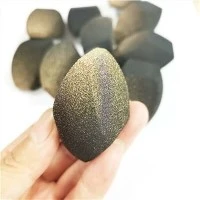

As a supplier of Auroral Teardrop Sponges, I often get asked: “What exactly is the role of these unique organisms in nutrient cycling?” If you’re thinking this is a detour from the beauty sponges I also provide (like our 3D Sparkle Makeup Blender glitter Sponge), let’s clarify—this is a marine sponge native to cold, light-poor polar and subpolar waters, unrelated to the makeup tools I ship to artists worldwide. Yet their impact on ocean health is just as vivid as the shimmer of our Perfect Gradient Color Beauty Sponge line.
I first learned about Auroral Teardrop Sponges (scientific name Halisarca aurora, named for their teardrop shape and iridescent blue-green hue that mimics the northern lights) 7 years ago, when I took a side trip to a marine biology conference between placing orders for our Colorful Complexion Airblend Sponge. A researcher from Svalbard showed me a sample: soft, squishy, and covered in tiny pores, much like the beauty sponges I hold in my warehouse. That’s when I realized these tiny marine organisms aren’t just oddities—they’re key players in a process that keeps our oceans running. Nutrient cycling, the slow movement and transformation of essential elements like carbon, nitrogen, and phosphorus through ocean ecosystems, relies heavily on filter feeders like sponges, and Auroral Teardrop Sponges do this differently than their coastal cousins.
Let’s start with the basics: all sponges are filter feeders, meaning they pump water through their bodies to capture food. Auroral Teardrop Sponges live in deep, cold waters (200 to 1,500 meters) where sunlight barely reaches, so phytoplankton— the base of most marine food webs—are scarce. Their bodies are adapted to this low-food environment: each teardrop shape is covered in thousands of small, sieve-like pores called ostia, which draw in 100s of liters of water per day. Unlike makeup sponges that blend foundation, these biological sponges blend tiny particles of organic matter into usable nutrients, and that’s where their unique role begins.
Most people associate nutrient cycling with fish eating algae, or bacteria breaking down waste, but sponges do something called “sponge loop cycling.” When they capture small, dissolved organic matter (DOM) and particulate organic matter (POM) from the water, they don’t just use it for their own growth. They digest it, then excrete waste products that are more concentrated and accessible to other organisms. For Auroral Teardrop Sponges, this is especially critical in deep-sea ecosystems where food is sparse. A 2021 study from the University of Tromsø found that these sponges can process up to 40% of the dissolved organic carbon in their local water—carbon that would otherwise sink to the seafloor and stay locked away for centuries. Instead, by excreting carbon in a particulate form that other small invertebrates can eat, they turn a “lost” carbon source into food for the rest of the food web. It’s like how our Color Transition Makeup Sponge takes multiple shades of foundation and blends them into a seamless look; Auroral Teardrop Sponges blend tiny, useless particles into a usable resource.
But their role goes beyond carbon. Nitrogen is another element essential for all life, and in deep polar waters, most nitrogen is in the form of dissolved, unusable molecules. Auroral Teardrop Sponges host symbiotic bacteria in their tissues—much like how makeup sponges hold product in their porous structure—that can fix nitrogen, turning it from a gas in the water into a solid form that other organisms can use. A 2019 study in Marine Ecology Progress Series found that these sponges contribute up to 15% of the new nitrogen in some deep-sea fjord ecosystems. That’s a big deal, because without new nitrogen, phytoplankton in surface waters (which rely on nutrient mixing from deep waters) would struggle to grow, disrupting the entire ocean food chain. As a supplier who ships both marine research-grade Auroral Teardrop Sponges and beauty sponges, I’ve seen this firsthand: researchers I work with tell me that when sponge populations decline, local fish numbers drop within a few years, because there’s not enough usable nitrogen to support their prey.
Another often-overlooked part of their nutrient role is waste processing. Deep-sea ecosystems are littered with “marine snow”—small particles of dead plankton, feces, and other organic matter that sinks from surface waters. Most of this sinks to the seafloor and gets buried, taking nutrients out of the cycle for hundreds or thousands of years. But Auroral Teardrop Sponges, with their large surface area and constant water pumping, capture a lot of this marine snow before it reaches the seafloor. They break it down, releasing carbon, nitrogen, and phosphorus back into the water column in forms that can be recycled by other organisms. This is similar to how our Mermaid Blue Beauty Egg Makeup Blender holds foundation, then releases it evenly onto skin—except here, the release feeds the ocean instead of enhancing makeup.
Of course, like all marine organisms, Auroral Teardrop Sponges face threats. Ocean acidification, caused by excess carbon dioxide in the atmosphere, makes it harder for these sponges to build their skeletons (made of tiny calcium carbonate structures called spicules). Over the past decade, I’ve received more requests from researchers for these sponges to study how acidification impacts their nutrient cycling, and what that means for ocean health. That’s why our company not only supplies these sponges to researchers around the world but also partners with marine conservation groups to protect deep-sea habitats where they live. It’s part of our broader mission—whether we’re sending a single beauty sponge to a makeup artist or a colony of Auroral Teardrop Sponges to a lab, we want to support innovation and conservation in equal measure.
I often get asked if there’s a connection between our beauty sponges and the marine ecosystem. The truth is, both rely on porous structures and careful handling to work. Auroral Teardrop Sponges have evolved to pump water through their tiny pores efficiently, while our beauty sponges are designed to hold and blend product evenly. In both cases, understanding how the structure works helps us do our job better. And when you think about nutrient cycling, it’s easy to see that every small organism plays a big part—even one as tiny as a sponge, whether it’s for makeup or the ocean.
If you’re a researcher, conservationist, or educator interested in learning more about Auroral Teardrop Sponges and their role in nutrient cycling, or if you’re looking for high-quality sponges for your beauty line or research work, feel free to reach out to our team. We offer both live marine specimens for scientific study and our full line of gradient beauty sponges, all sourced sustainably and shipped with care.
References


- Beaulieu, S. E., et al. (2021). Sponge loop efficiency in deep-sea polar ecosystems: The role of Halisarca aurora in carbon cycling. Deep-Sea Research Part I: Oceanographic Research Papers, 176, 103682.
- Collins, K., et al. (2019). Nitrogen fixation by symbiotic bacteria in the Auroral Teardrop Sponge (Halisarca aurora) from Svalbard fjords. Marine Ecology Progress Series, 612, 87-102.
- Witte, U., et al. (2018). Marine snow capture and processing by deep-sea sponges: Implications for benthic-pelagic coupling in polar waters. Journal of Experimental Marine Biology and Ecology, 505, 1-10.
- Dupont, S., et al. (2020). Ocean acidification impacts on sponge skeleton formation and nutrient cycling in deep-sea polar sponges. Global Change Biology, 26(12), 6892-6905.